
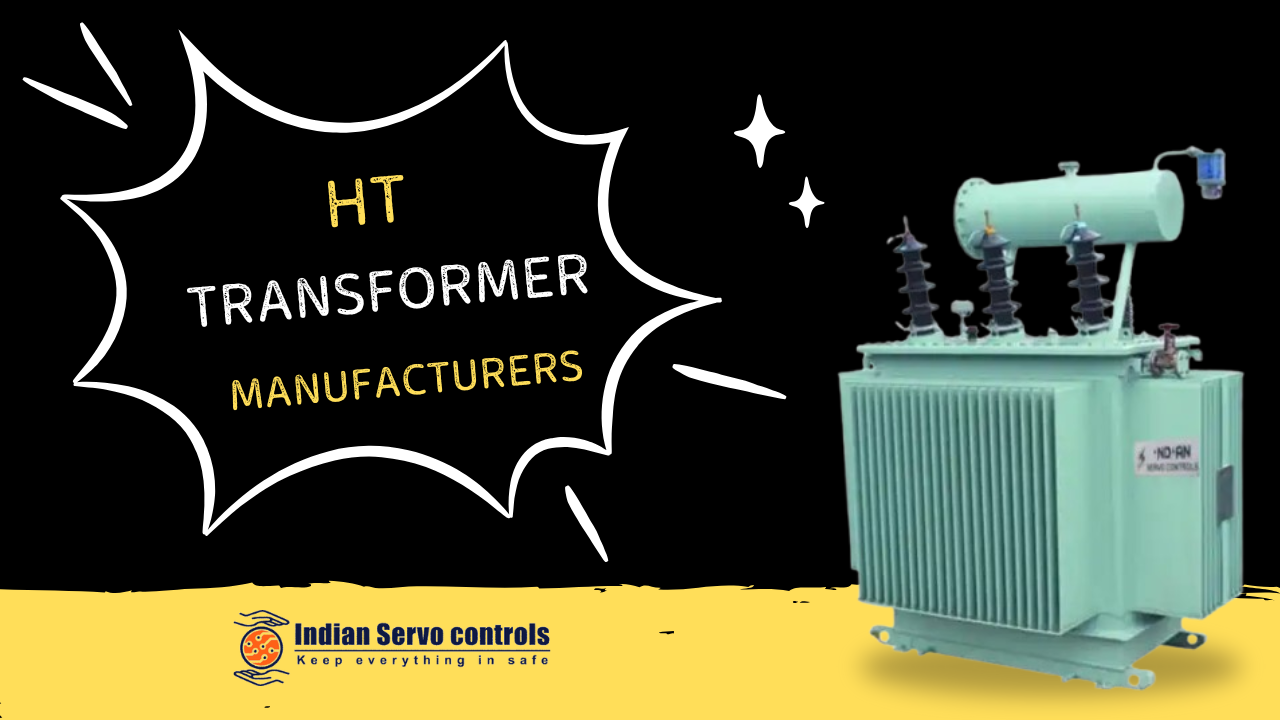
HT Transformer Manufacturers provide transformer solutions for industrial, commercial, infrastructure and electrical distribution applications where reliable voltage transformation is required. For businesses searching for HT Transformer Manufacturers in Lucknow UP, transformer selection should be based on actual electrical requirements such as capacity, primary voltage, secondary voltage, load characteristics, cooling method, tap-changing arrangement and installation conditions.
Indian Servo Controls provides HT transformers and related industrial power-control solutions for different electrical applications. Selecting a suitable transformer requires more than simply choosing a kVA or MVA rating. The complete electrical system, operating load and installation environment should be considered before the final transformer specification is determined.
This guide explains HT transformer working principles, common transformer types, industrial applications, selection factors, cooling considerations, maintenance requirements and the technical information buyers should provide when requesting a quotation.
What Is an HT Transformer?
An HT transformer is electrical equipment used to transform voltage from one level to another within a high-tension electrical system. Depending on the system design, a transformer may step down a higher incoming voltage for distribution and utilization or step up voltage where required by the electrical network.
HT transformers are used across industrial plants, substations, electrical distribution systems, infrastructure facilities and other installations where electrical power must be transferred between different voltage levels.
The transformer’s voltage ratio, capacity, insulation system, cooling arrangement and tap-changing mechanism should be selected according to the actual electrical requirement. This is why buyers comparing HT Transformer Manufacturers should provide accurate project and load information before finalizing equipment.
How Does an HT Transformer Work?
A transformer works on the principle of electromagnetic induction. Alternating current flowing through the primary winding produces changing magnetic flux in the transformer core. This magnetic flux induces voltage in the secondary winding.
The relationship between the primary and secondary winding turns determines the transformation ratio. This allows the transformer to increase or decrease voltage according to its design.
A simplified transformer operating process includes:
- Primary input: AC electrical power is supplied to the primary winding.
- Magnetic flux: Current flowing through the winding produces alternating magnetic flux in the transformer core.
- Voltage induction: Changing magnetic flux induces voltage in the secondary winding.
- Voltage transformation: The winding ratio determines the relationship between primary and secondary voltage.
- Power delivery: Electrical power is supplied from the secondary side to the connected electrical system.
Actual transformer construction also includes insulation, terminals, bushings, cooling components, protection-related provisions and other equipment appropriate to its capacity and voltage class.
Applications of HT Transformers
HT Transformer Manufacturers may supply transformers for a wide range of electrical and industrial applications. The required transformer configuration varies according to incoming voltage, required output voltage, connected load and operating environment.
Common application areas include:
- Industrial manufacturing facilities
- Electrical substations
- Power distribution networks
- Engineering plants
- Process industries
- Commercial facilities
- Infrastructure projects
- Renewable-energy installations
- Furnace and metallurgical applications
- Facilities operating large electrical loads
A high connected load does not automatically determine the correct transformer. Voltage levels, load characteristics, system configuration and operating conditions must also be evaluated.
Common Types Offered by HT Transformer Manufacturers
Different transformer configurations are used for different electrical applications. Customers comparing HT Transformer Manufacturers in Lucknow UP should first identify the transformer type that corresponds to their electrical system.
Distribution Transformers
Distribution transformers are used to transform electrical voltage to levels required for downstream distribution and utilization. Their capacity and voltage ratio vary according to the electrical network and connected load.
Indian Servo Controls provides distribution-transformer solutions for industrial and electrical distribution requirements. The exact rating, voltage ratio and configuration should be confirmed according to the individual project.
Explore the Distribution Transformer section for related product information.
Power Transformers
Power transformers are used where electrical energy must be transformed between voltage levels within power networks or industrial electrical systems.
The required capacity, primary voltage, secondary voltage, tap arrangement and cooling system depend on the electrical installation.
Learn more from the Power Transformer page.
OLTC Distribution Transformers
An OLTC distribution transformer incorporates an On-Load Tap Changer. This arrangement allows the transformer turns ratio to be adjusted while the equipment remains energized and operating within its specified conditions.
OLTC arrangements may be considered where voltage adjustment is required in response to changing supply or load conditions.
Off-Load Tap-Changing Transformers
An off-load tap changer provides selectable transformer tap positions, but the adjustment is performed according to the equipment’s specified de-energized operating procedure.
Whether an OLTC or off-load arrangement is suitable depends on the voltage-control requirement and operating conditions of the electrical system.
Oil-Immersed Transformers
Oil-immersed transformers use insulating liquid as part of their insulation and heat-transfer system. This construction is commonly used across electrical distribution and industrial applications.
The suitability of an oil-immersed transformer depends on its capacity, voltage class, installation conditions, environmental requirements and project specifications.
Dry-Type Transformers
Dry-type transformers use solid insulation and air-based cooling arrangements instead of transformer oil as the primary insulating medium.
They may be considered for installations where their construction and operating characteristics correspond to the project’s technical and environmental requirements.
8 Important Factors for Selecting HT Transformer Manufacturers
Choosing between HT Transformer Manufacturers requires more than comparing transformer prices or capacity. Buyers should evaluate the proposed equipment against the complete electrical requirement.
1. Primary Voltage
The incoming voltage supplied to the transformer must be clearly specified. This is necessary for determining the required primary winding and insulation arrangement.
2. Required Secondary Voltage
The secondary voltage should correspond to the downstream distribution system and the electrical equipment that will receive power from the transformer.
3. Transformer Capacity
The required kVA or MVA rating should be determined from connected load, expected demand, operating characteristics and appropriate engineering considerations.
4. Load Characteristics
Different electrical loads create different operating requirements. Motors, furnaces, production machinery, power-electronic equipment and general distribution loads may require different transformer considerations.
5. Cooling Method
The cooling arrangement should correspond to transformer construction, capacity, operating environment and project requirements.
6. Tap-Changing Requirement
Buyers should determine whether the application requires a fixed transformation ratio, off-load tap adjustment or an on-load tap-changing arrangement.
7. Installation Environment
Indoor or outdoor location, ambient conditions, available space, ventilation, accessibility and environmental exposure should be considered during transformer selection.
8. Protection Requirements
The transformer should be coordinated with the protection scheme specified for the electrical installation. Protection requirements should be determined as part of the system design rather than assumed from a generic transformer configuration.
Indian Servo Controls Transformer Solutions
Indian Servo Controls provides different transformer and power-control solutions for industrial electrical applications. The final equipment configuration depends on individual project requirements, so customers should confirm the current technical specification before procurement.
Distribution Transformer
Distribution transformers can be configured according to required capacity, incoming voltage, output voltage and installation conditions. The correct configuration should be determined from the actual electrical system rather than using a generic specification for every installation.
OLTC Distribution Transformer
OLTC distribution transformers can be considered where adjustment of the transformer ratio while energized forms part of the voltage-control strategy.
The required tap range and control arrangement should be established from the electrical system requirements.
Furnace Transformer
Furnace transformers are intended for specialized industrial furnace loads. Their electrical characteristics may differ from standard distribution transformers because furnace applications can involve demanding load profiles and operating conditions.
Visit the Furnace Transformer page for related information.
Solar Transformer
Solar installations may require transformers for integration between inverter output, collection systems and the required electrical network voltage.
Transformer selection for a solar installation depends on inverter characteristics, plant capacity, system voltage, network requirements and overall electrical design.
Explore the Solar Transformer section.
Power Transformer
Power transformers can be used in industrial and power-distribution systems requiring voltage transformation between different electrical levels.
Capacity, voltage class, cooling system and tap arrangement should be selected according to the actual project specification.
HT Transformer and HT AVR: Understanding the Difference
An HT transformer and an HT AVR perform related but different functions within an electrical system.
A transformer primarily transforms voltage from one level to another according to its winding ratio and design. An HT AVR is used for voltage regulation where incoming voltage variation must be controlled within the requirements of the connected system.
Depending on the electrical design, voltage transformation and voltage regulation may need to be considered together.
More information is available from the HT AVR product section.
Related Servo Voltage Stabilizer Solutions
Where an application requires voltage stabilization rather than only voltage transformation, a servo voltage stabilizer may be considered according to the electrical requirement.
Important selection factors can include:
- Incoming voltage variation
- Required regulated output
- Connected load
- Balanced or unbalanced load conditions
- Installation environment
- Electrical-system configuration
Explore related equipment on the Servo Voltage Stabilizer page.
Information to Provide HT Transformer Manufacturers in Lucknow UP
When requesting a quotation from HT Transformer Manufacturers in Lucknow UP, providing accurate technical information helps manufacturers understand the actual electrical requirement.
Useful information can include:
- Required transformer capacity in kVA or MVA
- Primary voltage
- Required secondary voltage
- System frequency
- Number of phases
- Connected load details
- Load characteristics
- Required tap range or tap-changing arrangement
- Indoor or outdoor installation
- Site environmental conditions
- Cooling requirements
- Electrical single-line diagram where available
- Applicable project specifications
- Required monitoring, metering or accessories
Where these parameters have not yet been established, the electrical system should be evaluated by appropriately qualified professionals before the final transformer specification is selected.
Why Load Assessment Matters Before Transformer Selection
Transformer capacity should not be selected solely by adding equipment nameplate ratings. The way electrical loads actually operate should also be considered.
Important load factors can include:
- Normal operating load
- Maximum expected demand
- Motor starting conditions
- Load diversity
- Operating duty
- Expected future expansion
- Characteristics of nonlinear or specialized loads
A proper load assessment provides useful information that can be shared with HT Transformer Manufacturers when determining an appropriate transformer configuration.
Transformer Cooling and Installation Considerations
Transformer operation generates heat because of electrical and magnetic losses. The equipment therefore requires a cooling arrangement appropriate to its construction and operating conditions.
Installation planning should consider:
- Equipment location
- Electrical clearances
- Ventilation
- Foundation requirements
- Cable routing and termination
- Earthing arrangements
- Access for inspection and maintenance
- Environmental exposure
- Coordination with switchgear and protection equipment
Actual installation requirements should follow the equipment documentation, project design and applicable electrical requirements.
Testing and Documentation for HT Transformers
Testing requirements can vary according to transformer type, voltage class, capacity, applicable standards and customer specifications.
Before procurement, buyers should establish the testing and documentation required for their project. Depending on the equipment and project, documentation may include technical drawings, rating information, test documentation and equipment-specific operating instructions.
These requirements should be agreed during technical evaluation instead of assuming that all HT Transformer Manufacturers provide identical equipment or documentation.
Maintenance Considerations for HT Transformers
Transformer maintenance requirements depend on construction, operating environment, loading conditions and manufacturer instructions.
Inspection areas may include:
- General physical condition
- Electrical connections and terminals
- Bushings
- Signs of abnormal heating
- Cooling components
- Oil level and leakage where applicable
- Earthing connections
- Associated protection equipment
- Tap-changing equipment where fitted
- Unusual noise or vibration
The inspection and maintenance schedule should follow the requirements applicable to the specific transformer and electrical installation.
Official References for Transformer Projects
Transformer projects can be subject to technical standards and regulatory requirements depending on equipment type, voltage class, application and installation.
The Bureau of Indian Standards (BIS) provides official information about Indian Standards and conformity-assessment activities. Project teams can consult relevant BIS information when identifying standards applicable to their equipment.
The Central Electricity Authority (CEA) provides official information and regulations relating to India’s electricity sector.
Applicable standards and compliance requirements should be identified for the particular project instead of assuming that every transformer installation has identical requirements.
Questions to Ask HT Transformer Manufacturers
Before finalizing equipment, buyers can ask HT Transformer Manufacturers detailed questions about the proposed configuration.
- What transformer capacity is proposed for the stated load?
- What primary and secondary voltage is specified?
- What cooling arrangement is proposed?
- Is an off-load or on-load tap changer required?
- What tap range is proposed?
- What installation conditions should be maintained?
- What technical drawings and documentation will be supplied?
- What testing applies to the proposed transformer?
- What maintenance requirements apply to the equipment?
This allows transformer proposals to be compared according to actual technical requirements instead of unsupported rankings or promotional claims.
HT Transformer Manufacturers in Lucknow UP – Discuss Your Requirement
Businesses searching for HT Transformer Manufacturers in Lucknow UP should begin by defining transformer capacity, primary voltage, secondary voltage, connected load, installation environment and tap-changing requirements.
Indian Servo Controls provides transformer, servo voltage stabilizer, HT AVR and related industrial power-control solutions. Equipment configuration should be determined according to the electrical characteristics and technical requirements of each project.
For transformer and industrial power-solution information, visit Indian Servo Controls or explore the Indian Servo Controls product range.
Frequently Asked Questions About HT Transformer Manufacturers
What is an HT transformer?
An HT transformer is electrical equipment used within a high-tension electrical system to transform voltage between required levels. Its voltage ratio, capacity and construction depend on the application and electrical-system design.
Where are HT transformers commonly used?
HT transformers can be used in industrial facilities, substations, electrical distribution networks, infrastructure projects, renewable-energy installations and other applications requiring voltage transformation.
What information should I give HT Transformer Manufacturers?
Provide the required transformer capacity, primary voltage, secondary voltage, connected load, load characteristics, installation environment, tap-changing requirements and relevant project specifications.
What is the difference between OLTC and off-load tap changing?
An OLTC is designed to change transformer tap positions while the transformer remains energized and operating within its specified conditions. An off-load tap changer is adjusted according to the equipment’s specified de-energized procedure.
How do I choose between oil-immersed and dry-type transformers?
The choice depends on capacity, voltage class, installation environment, cooling and insulation requirements, space constraints and project specifications. The appropriate construction should be determined through technical evaluation.
How should I compare HT Transformer Manufacturers in Lucknow UP?
Compare the proposed capacity, voltage ratio, cooling arrangement, tap-changing system, testing requirements, technical documentation and suitability for the intended electrical installation. These factors provide a more useful comparison than unsupported rankings or promotional claims.
14 thoughts on “HT Transformer Manufacturers in Lucknow UP”
Comments are closed.